

What a session may involve
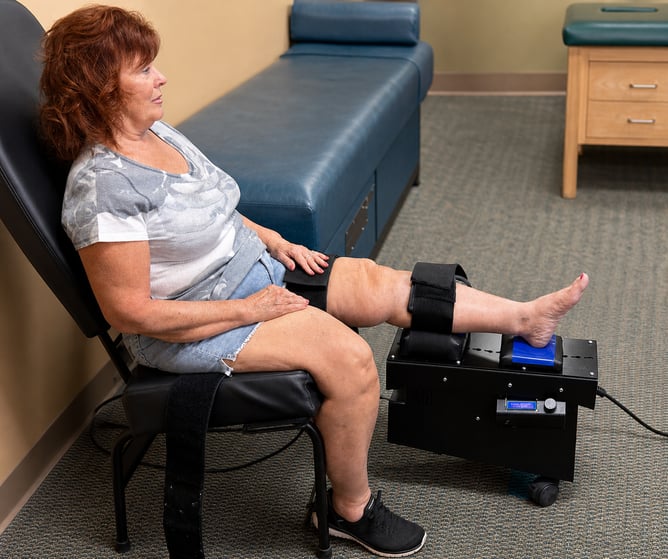
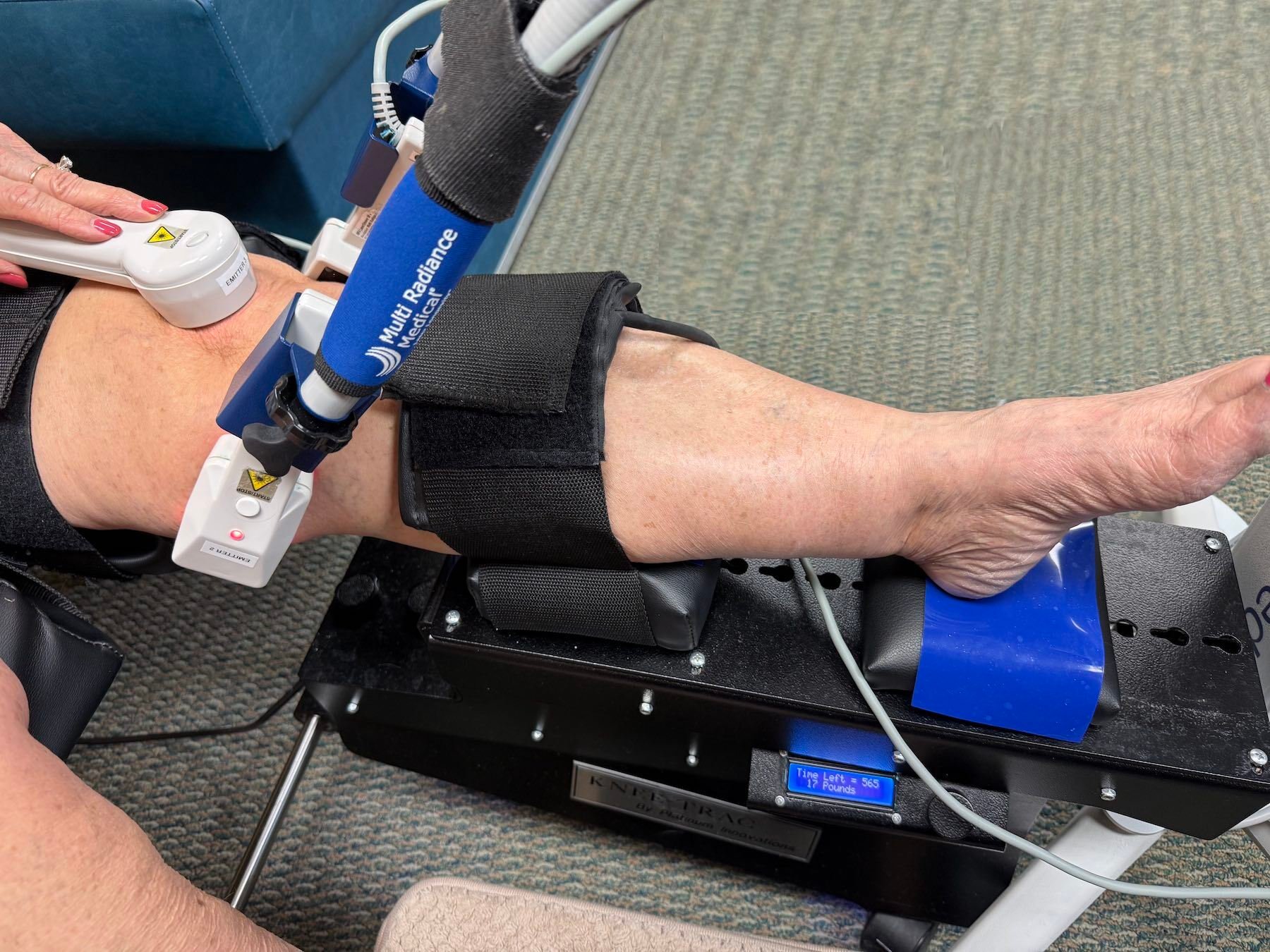
A typical session lasts about 8 to 15 minutes per knee. You are seated with your leg positioned comfortably while the upper thigh is stabilized and an inflatable cuff supports the lower leg and secures it to the tractioni mechanism. We use special material to decrease any slippage of the lower leg as tracion is applied. The pull is adjusted to your needs and comfort level and is precision computer controlled.
What you may notice early on
Some people notice changes in comfort or motion within the first few visits. Others require a longer course of care depending on how long the problem has been present, the condition of the joint, surrounding soft tissues, and the neurological and biomechanical factors involved.
What other treatments may be used along with Knee-Trac?
Every case is different. Your plan is tailored to your specific case based on your examination and imaging findings. Your plan may include one or more of the following along with Knee Trac:
- Specific spinal adjustments to address nerve involvement affecting the muscles that support the knee
- Extremity adjustments to the ankle, knee, and hip
- Trigenics® to help improve abnormal muscle firing patterns and support better strength and movement
- Class IV Laser Therapy
- Pulsed Electromagnetic Field Therapy (PEMF)
- Nutritional support for tissue healing, inflammation control, and nerve support
- Individualized exercises or movement recommendations
- Foot Levelers orthotic recommendations when needed
Your plan is tailored to your specific case based on your examination and imaging findings.
Who may be a candidate?
People with chronic knee pain, osteoarthritic degeneration, older sprain or strain patterns, certain meniscus-related complaints, and movement limitations may be candidates for this type of care. The first step is a consultation and examination so I can determine what is driving your knee pain and whether this approach is appropriate for you.
Why a broader evaluation matters
Many chronic knee pain sufferers are told they simply have to live with it, reduce activity, or prepare for more invasive procedures. In some cases, that advice is premature.
The source of knee pain is not always the knee joint alone. Loss of motion in the hip or ankle, altered spinal mechanics, weakness in the supportive muscles, and poor nerve-to-muscle communication can all change how the knee functions. When those factors are missed, the knee may continue to be overloaded.
Let me explain it another way. If one link in a chain is not working correctly, the entire chain is affected. The same is true with the lower body. To help your knee, we often need to improve the quality of motion and control throughout the whole system.
What you may notice
The goals of care are straightforward:
- Less pain with walking, standing, and stairs
- Better knee motion
- Improved confidence when getting up from a chair or moving around
- Better support from the muscles that cross the knee
- A plan built around your specific findings rather than a one-size-fits-all routine
Frequently asked questions
Is Knee-Trac the only treatment I would receive?
Not usually. Every case is different. Your plan is tailored to your specific case based on your examination and imaging findings.
- Specific spinal adjustments to address nerve involvement affecting the muscles that support the knee, along with extremity adjustments to the ankle, knee, and hip because the whole kinetic chain must be taken into account.
- Extremity adjustments to the ankle, knee, and hip
- Trigenics® to help improve abnormal muscle firing patterns and support better strength and movement
- Class IV Laser Therapy
- Pulsed Electromagnetic Field Therapy (PEMF)
- Nutritional support for tissue healing, inflammation control, and nerve support
- Individualized exercises or movement recommendations
- Foot Levelers orthotic recommendations when needed
What does a session feel like?
Most people describe the pull as gentle and is computer controlled. Your leg is supported and positioned carefully while the settings are adjusted to your comfort level.
How soon might I notice a change?
Some people notice changes in comfort or motion within the first few visits. Others need a longer process depending on the severity of the problem, the amount of degeneration present, and the other factors contributing to the knee pain.
How do you decide what care I need?
I make that decision based on your history, examination findings, movement patterns, and imaging. Your plan is designed around your specific case rather than a generic knee protocol.
Take a closer look at your chronic knee pain
If your knee pain has been limiting your walking, exercise, stairs, or daily life, it may be time to take a closer look at what is really driving the problem. In many cases, better answers begin with a more complete evaluation of the joint mechanics, the supporting muscles, and the neurological control of the entire lower-extremity chain.

To schedule an appointment with us, call 586-731-8840.
*The trademark Trigenics® is owned by the International Institute of Trigenics® Inc. Johnson Chiropractic Neurology & Nutrition is a licensee of the trademark