

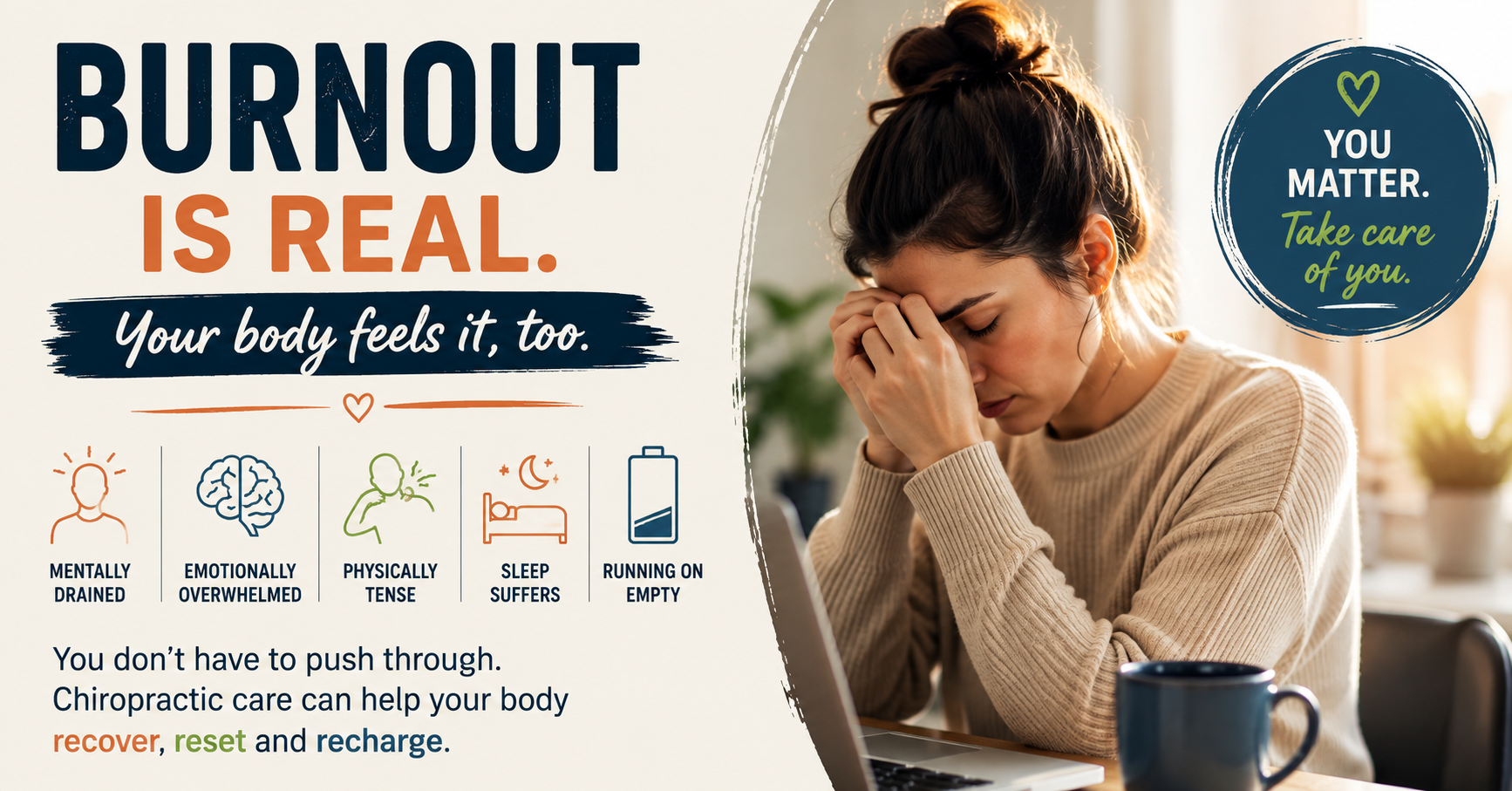
 You wake up tired.
Your shoulders feel tight. Your neck aches. You have not been sleeping well. Headaches are showing up more often. You feel short-tempered with people you care about, your focus is slipping, and even things you usually enjoy can start to feel like one more demand on your time.
Many people tell themselves:
“I’m just busy. Things will get better when life slows down.”
But what if life does not slow down?
What if your body has been trying to get your attention for weeks or even months?
You may be running on empty.
Burnout Isn't Just in Your Head
When people hear the word burnout, they often think only about emotional exhaustion. They think about feeling overwhelmed, irritable, discouraged, or mentally drained.
That is part of the picture, but it is not the whole picture.
Long periods of stress can affect both your mind and your body. When your schedule stays packed, your responsibilities keep piling up, and your nervous system rarely gets a chance to settle down, your body may remain stuck in a stress-driven state for too long.
Over time, that can show up in ways that are hard to ignore. 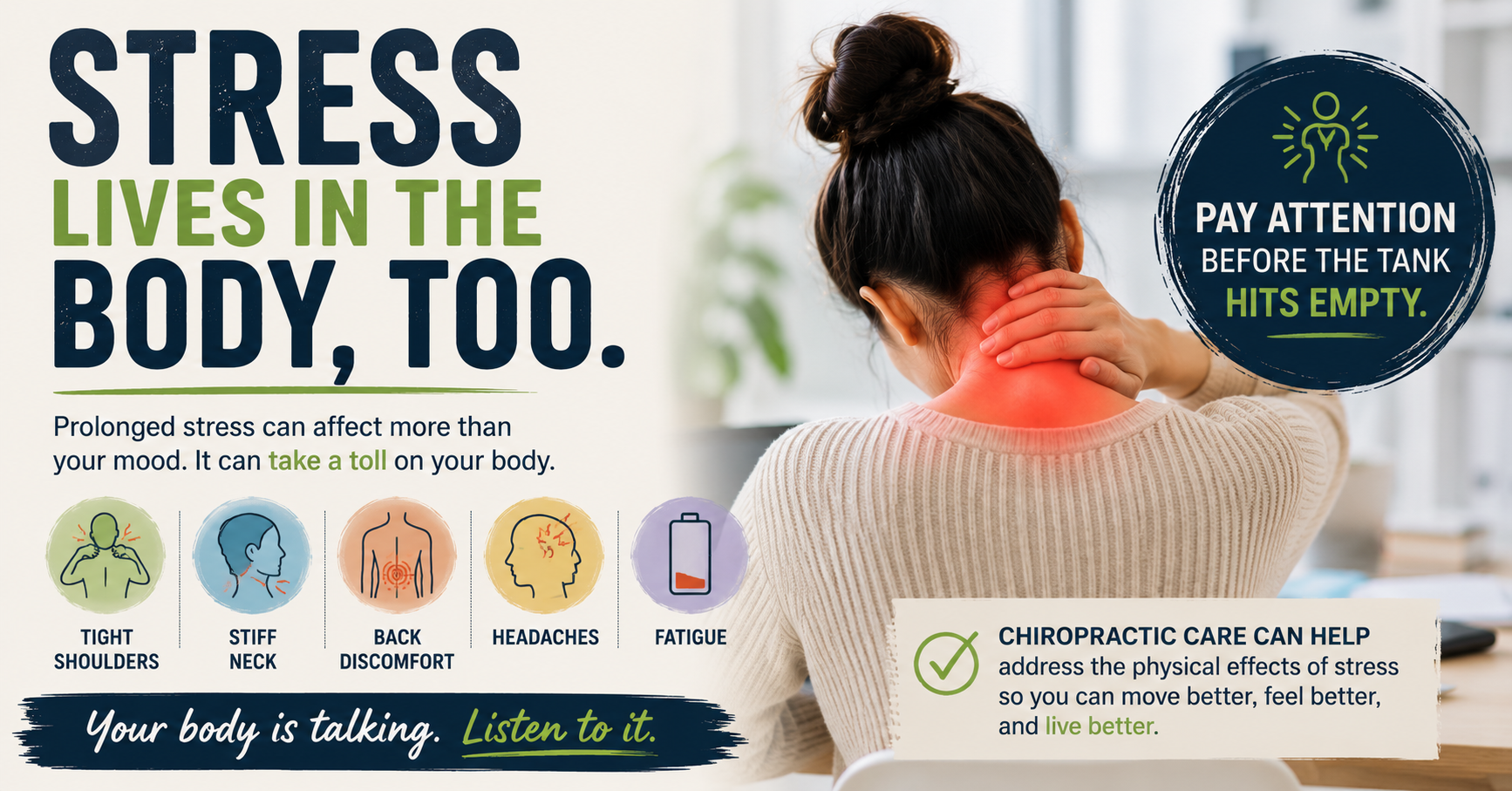 Common signs that may be associated with prolonged stress and burnout include:
- Persistent fatigue, even after resting
- Difficulty falling asleep or staying asleep
- Headaches
- Neck, shoulder, or back discomfort
- Muscle tension
- Trouble concentrating
- irritability or emotional exhaustion
- Changes in appetite
- Decreased motivation
- Less interest in exercise, hobbies, or social activities
- Feeling like you are constantly “on”
Your body may be telling you that something needs attention.
Your Body Has a Stress Response for a Reason
Stress is not always the enemy.
Your body’s stress response is designed to help you deal with challenges. When something stressful happens, your nervous system prepares you to respond. That can be helpful in the right moment.
The problem is that modern stress often does not end when the immediate challenge is over.
Instead, it keeps going:
- The messages keep coming
- The phone keeps buzzing
- The deadlines keep shifting
- The bills still need to be paid
- Tomorrow’s schedule already looks full
When stress becomes chronic, your body may have fewer chances to truly recover. That matters because chronic stress can begin affecting several areas at once, including:
- Sleep quality
- Muscle tension
- Posture
- Energy levels
- Physical activity
- Recovery capacity
Let me explain.
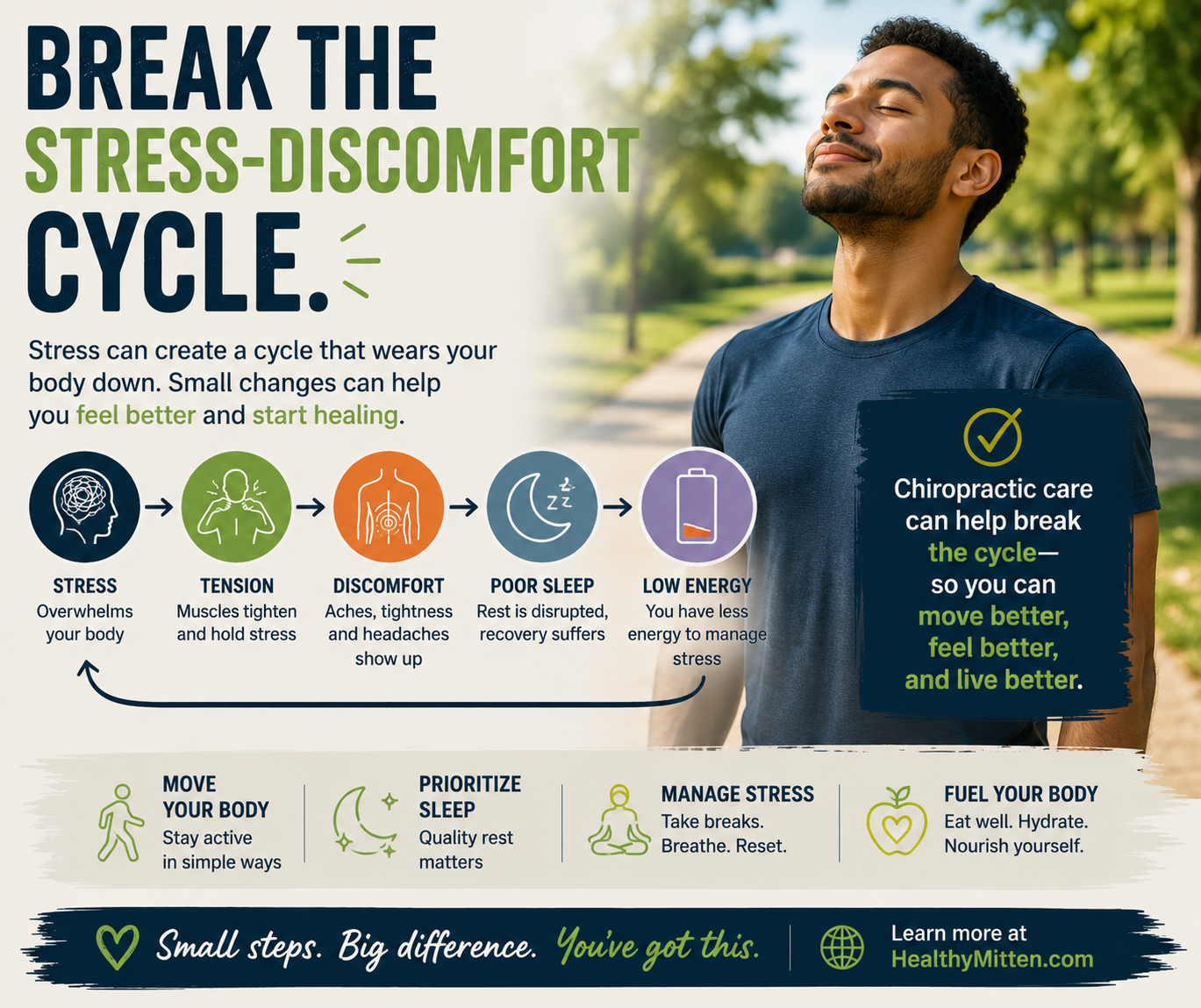
If you are tired, you may move less. If you move less, your body may become stiffer. If your body feels stiffer and more uncomfortable, sleep may suffer. When sleep suffers, your ability to handle stress often suffers too.
That is how a cycle begins.
- Stress contributes to tension
- Tension may contribute to discomfort
- Discomfort may interfere with sleep
- Poor sleep may leave you with less energy to move, exercise, and recover
Before long, your body can feel like it is working against you when it is really asking for help.
Where Does Chiropractic Care Fit In?
 Chiropractic care is not a magic off switch for stress, and it is not a cure for emotional or mental burnout.
It can, however, be an important part of a larger, personalized care plan when stress is accompanied by physical tension, reduced mobility, headaches, neck discomfort, back discomfort, or other neuromusculoskeletal challenges.
Doctors of chiropractic evaluate how the joints, muscles, posture, movement patterns, and daily habits may be affecting how you feel. In some cases, those physical stress patterns build gradually and become part of everyday life before a person realizes how much they are being affected.
Depending on your individual needs, care may include:
- Spinal or extremity adjustments
- Stretching or mobility recommendations
- Exercises to support better movement
- Postural or ergonomic guidance
- Other conservative, non-invasive approaches that may help improve function and comfort
Why does that matter?
Because when your body moves better, other healthy choices may start feeling more possible.
For example:
- When turning your head is more comfortable, a walk may sound more manageable
- When your back is less irritated in the evening, staying active may feel easier
- When your body is not fighting you at every step, healthy routines may be easier to rebuild
Don't Wait Until the Tank Is Empty
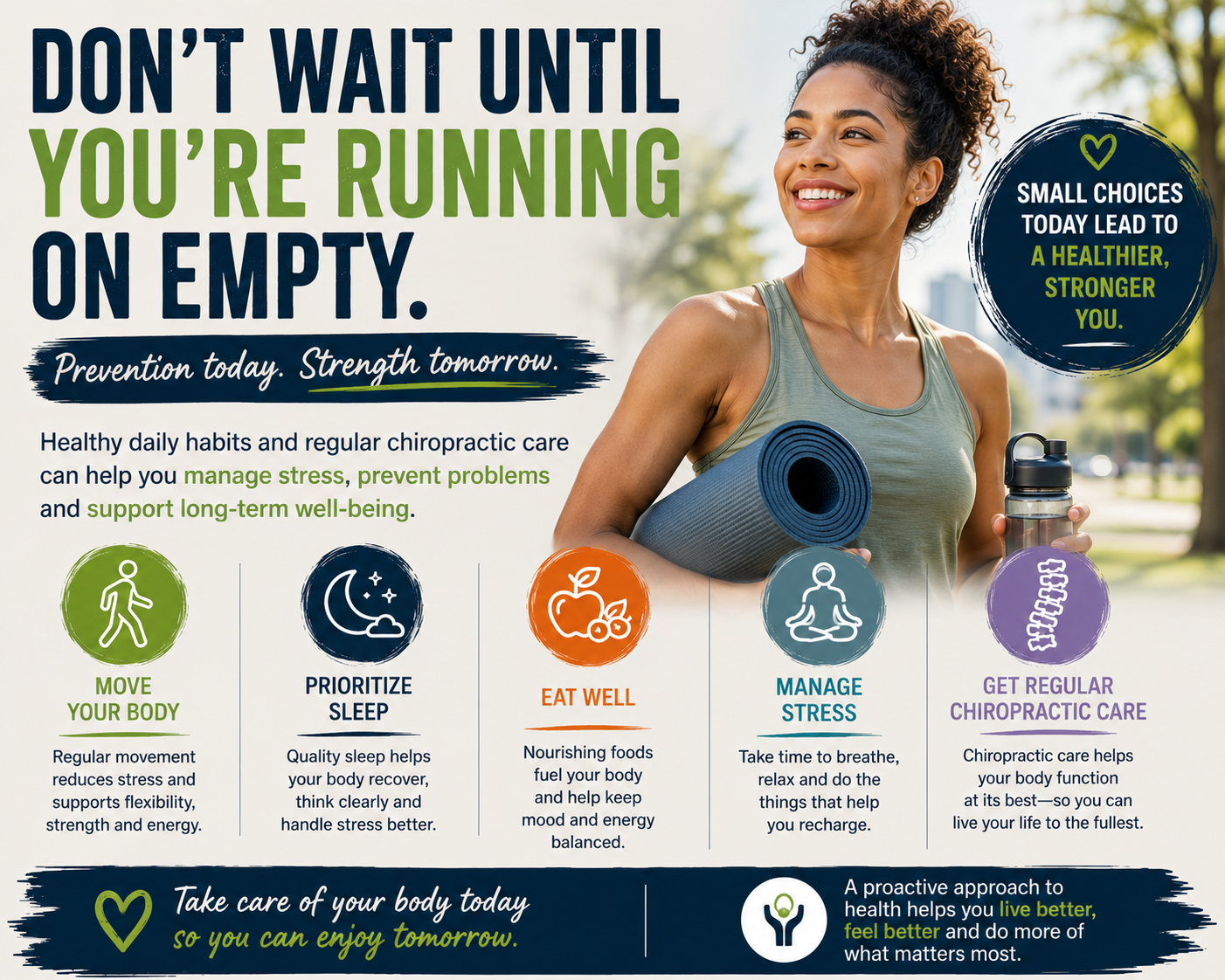 One of the biggest mistakes many people make is waiting until they are completely exhausted before doing something about stress.
Think about the warning lights in your car.
You would not ignore a warning light for months and assume everything will work itself out.
Yet people often do something very similar with their bodies.
Warning lights may include:
- The stiff neck that shows up every afternoon
- The headaches that are becoming more frequent
- The backache you keep pushing aside
- The restless nights when you cannot get comfortable
- The exhaustion that never fully lifts
They may be your body’s way of telling you that the current pace is costing you more than you realize.
Five Ways to Start Refilling Your Tank
Recovering from burnout is usually not about making one huge change overnight. More often, it begins with smaller, consistent choices that give your mind and body a chance to recover.
1. Protect your sleep
Sleep is not a luxury. It is one of the main ways your body restores itself.
A few simple steps may help:
- Keep a more consistent bedtime
- Reduce screen time before bed
- Make sleep part of your schedule instead of what gets squeezed in last
- Create a bedroom routine that helps your body wind down
You do not need an intense workout every day.
In many cases, regular movement may help support circulation, mobility, and stress recovery. Consider simple options such as:
- Walking
- Gentle stretching
- Gardening
- Biking
- Getting up from your desk throughout the day
3. Give yourself real breaks
Scrolling while answering emails is usually not much of a break.
Instead, give your brain and body a true pause:
- Step away from the screen
- Go outside if you can
- Eat lunch somewhere other than your desk
- Take a short walk
- Breathe and let your body settle
4. Pay attention to physical discomfort
Do not ignore persistent aches, stiffness, headaches, or reduced mobility.
Those signs may not tell the whole story by themselves, but they do deserve attention. If something feels off, it may be time to speak with an appropriate healthcare professional and look deeper rather than simply pushing through.
5. Know when you need more support
Burnout can involve physical, emotional, and mental health factors.
Chiropractic care may help address certain physical aspects, but it is not a substitute for mental health care or medical care when those are needed. If you are dealing with persistent anxiety, depression, severe exhaustion, or other concerning symptoms, talk with your healthcare provider or a qualified mental health professional.
Sometimes the best next step is a team approach.
There is nothing wrong with that.
You Can't Pour From an Empty Cup
 People spend tremendous amounts of energy taking care of everything around them.
- Their work
- Their family
- Their home
- Their responsibilities
- Their community
You.
Taking care of your physical health is not selfish. It is part of what allows you to keep showing up for the people and responsibilities that matter most.
So take a moment and check your gauge.
Ask yourself:
- Am I sleeping well?
- Am I moving enough?
- Am I carrying more tension than I realize?
- Are my aches and headaches becoming more frequent?
- Have I been recovering, or only pushing through?
Take a closer look. Listen to what your body may be saying. Give yourself permission to slow down enough to begin refilling the tank.
And if this message reminds you of someone else who has been running on empty, please share it with them.

If you’d like to understand more about the natural, whole-person approach that guides my work, I invite you to explore what makes my philosophy of care unique.
Always remember one of my guiding principles: the more you understand how your body works, the better you can care for yourself and support your long-term health.
For a deeper look at the natural, whole-person approach I use with my patients, you may enjoy my book, Reclaim Your Life: Your Guide To Revealing Your Body’s Life-Changing Secrets For Renewed Health. It is available in my office, on Amazon, and through many other booksellers.
If this article was helpful, please use the social sharing icons at the top of the post and share it with those who are still living with chronic health challenges despite medical management. Together, we can reach more people and help them regain their enthusiasm for living. Thank you.